?>

Category: Career Guide

Honest career advice for students in Jind and Haryana who want to build skills in digital marketing.

  • Digital Marketing vs MBA vs Government Job Prep: What Should a B.Com Graduate Choose?

    Digital Marketing vs MBA vs Government Job Prep: What Should a B.Com Graduate Choose?

    Digital Marketing vs MBA vs Government Job Prep: What Should a B.Com Graduate Choose?

    By Kunal Bansal, Founder, Zoom in Success · Career Guide
    Digital marketing vs MBA vs government job prep after B.Com

    You’ve finished B.Com. Your relatives say “government job lo”. Your friends are filling MBA forms. And Instagram keeps showing you people earning from digital marketing. Which one is the right career after B.Com for you?

    I did a B.Com myself before building a career in digital marketing, so I’ve faced this exact question. This guide won’t tell you that one path is perfect. Each has real advantages and real risks. The goal is to help you choose based on your situation, not on pressure or hype.

    The three paths at a glance

    Digital marketingMBAGovernment job prep
    Time before you earnOften 3–6 months of serious learning2 years of study, plus job searchUncertain: often 1–3+ years
    Upfront costLowHigh (depends heavily on the college)Low to moderate (coaching, books, forms)
    How you get inSkills and a portfolioEntrance exams (CAT, MAT, CMAT etc.)Competitive exams (SSC, banking, state exams)
    Main riskPay depends on your skill and the marketA weak college may not lead to good placementsVery high competition for limited seats
    Job securityLower, but skills move with youMediumVery high once selected
    Can you freelance?Yes, from early onNot usuallyRestricted once employed

    Path 1: Digital marketing

    Good for you if you need to start earning soon, you enjoy creative and fast-changing work, and you’re willing to learn by doing.

    • Pros: low cost to start; you can begin freelancing for local businesses within months; skills work in any city or online; you don’t need an entrance exam.
    • Cons: no guaranteed salary; you must keep learning because platforms change constantly; early income can be irregular.
    • Reality check: watching videos is not enough. Employers want proof, meaning reels you’ve made, ads you’ve run and websites you’ve built. Read how to build a digital marketing portfolio with zero clients.

    Path 2: MBA

    Good for you if you can get into a well-regarded college, your family can support two more years of study, and you’re aiming for corporate management roles.

    • Pros: strong network and structured placements at good colleges; opens doors to management roles in large companies.
    • Cons: expensive; two years without full-time income; the value depends heavily on the college. An MBA from a weak college often doesn’t lead to the placements students expect.
    • Reality check: check a college’s actual placement report, not its advertisement, before you pay.

    Path 3: Government job preparation

    Good for you if job security matters most to you and your family, you’re comfortable with long, focused study, and you can support yourself during preparation.

    • Pros: excellent job security, fixed working hours in many roles, pension and allowances, and strong respect in society, especially in Haryana.
    • Cons: lakhs of candidates compete for a limited number of posts, so selection can take years, and some never clear it despite working hard. Exam calendars and results can also be delayed.
    • Reality check: set a time limit (for example, two serious attempts) and have a Plan B ready.
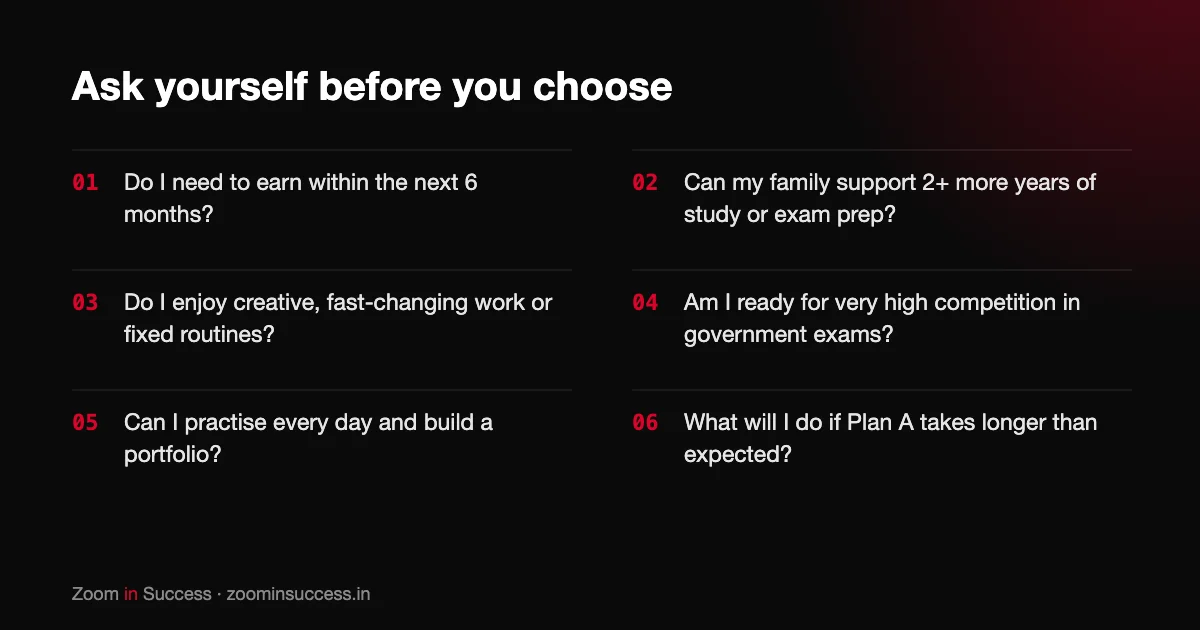
    Questions a B.Com graduate should ask before choosing a career path

    You don’t always have to pick just one

    These paths can work together:

    • Government prep + digital skills: many aspirants learn digital marketing as a backup and earn from freelance projects while they prepare.
    • Digital marketing first, MBA later: a couple of years of real work experience makes your MBA far more valuable, and you’ll know which specialisation you actually want.
    • MBA in marketing + practical skills: MBA students who can actually run campaigns stand out in placements.

    A simple way to decide

    1. If you must earn within 6 months, start with a practical skill like digital marketing.
    2. If you can get into a good college and afford it, an MBA can be a strong long-term investment.
    3. If security matters most and you can study for years, prepare for government exams with a clear deadline and a backup skill.

    Whatever you choose, choose it yourself, with full information, and not because of what everyone else is doing.

    Frequently asked questions

    Is digital marketing a good career after B.Com?

    It can be. Your commerce background helps you understand budgets, sales and return on investment, which are the heart of performance marketing. Success depends on practical skills and a portfolio, not on your degree marks.

    Can I learn digital marketing while preparing for government exams?

    Yes. Many students take a short course and freelance a few hours a day. It gives you income and a backup plan without stopping your preparation.

    Do I need an MBA to get a job in digital marketing?

    No. Most digital marketing roles hire on skills and proof of work. An MBA can help later for senior management roles.


    Want to try digital marketing before you decide? Visit us at Palika Bazaar, Jind, or message us on WhatsApp at +91 81685 27715. We’ll tell you honestly whether it suits you. You can also look at our digital marketing course in Jind, which more than 10 of our former students have used to move into digital marketing jobs.
  • How to Build a Digital Marketing Portfolio With Zero Clients

    How to Build a Digital Marketing Portfolio With Zero Clients

    How to Build a Digital Marketing Portfolio With Zero Clients

    By Kunal Bansal, Founder, Zoom in Success · Career Guide

    How to build a digital marketing portfolio with zero clients

    It’s the classic trap: you can’t get clients without a portfolio, and you can’t build a portfolio without clients. Every fresher trying to build a digital marketing portfolio hits this wall.

    Here’s the good news: you don’t need a paying client to prove you can do the work. You need real projects with real results, even small ones. This guide shows you exactly what to build, step by step.

    Why a portfolio beats a certificate

    Certificates show that you studied. A portfolio shows that you can deliver. When an agency or a business owner looks at your profile, they want to see three things:

    • What you made: reels, ad creatives, websites, posts.
    • Why you made it that way: your thinking, not just the output.
    • What happened: numbers like reach, clicks, leads or cost per lead, even if they’re small.
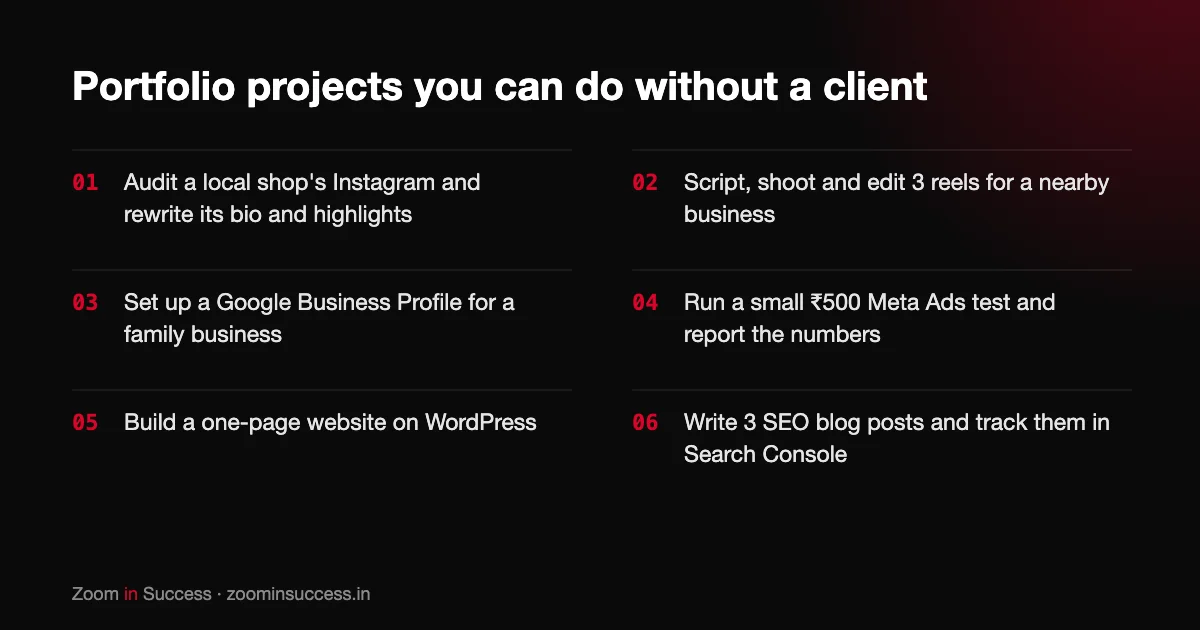
    Six digital marketing portfolio projects you can do without a client

    6 portfolio projects you can do without a client

    1. Audit a local shop’s Instagram

    Pick a shop in your city whose Instagram page could be better. Write a one-page audit: what’s working, what isn’t, and five specific fixes (bio, highlights, posting pattern, reel ideas, call to action). Then show a “before vs after” mock-up of the profile.

    Bonus: walk into the shop and show them the audit. That’s how many of our students land their first freelance client.

    2. Script, shoot and edit 3 reels for a nearby business

    Offer a sweet shop, gym, boutique or coaching centre three free reels. Write a hook for each, shoot on your phone, and edit in CapCut. Track the views and saves after a week. Three reels with real numbers beat thirty imaginary ideas.

    3. Set up a Google Business Profile

    Many family businesses still aren’t on Google Maps properly. Set up or fix their Google Business Profile: correct category, photos, opening hours and the first few reviews. Screenshot the profile’s views and calls after a month. Local SEO is one of the most in-demand skills for small businesses.

    4. Run a small ₹500 Meta Ads test

    Nothing teaches ads like spending your own money. Run a small campaign, for a friend’s business or even to promote your own reel. Set a clear goal, test two creatives, and write down the results: reach, clicks, cost per result, and what you’d change next time. Employers love a candidate who has actually seen Ads Manager.

    5. Build a one-page website on WordPress

    Make a simple landing page for a real or imagined business: headline, services, testimonials, WhatsApp button, contact form. Make sure it’s fast and works on mobile. This also becomes your own portfolio site later.

    6. Write 3 SEO blog posts and track them

    Start a small blog on any topic you know well. Do keyword research, write three helpful posts, and connect Google Search Console. After a few weeks, screenshot your impressions and clicks. Even 50 impressions prove that you understand how search works.

    How to present each project

    Use the same simple structure for every project so it’s easy to read:

    1. The problem: “A local boutique had 300 followers and no enquiries from Instagram.”
    2. What you did: “Rewrote the bio, made 3 reels, added a WhatsApp link.”
    3. The result: “One reel reached 4,200 people; the page got 9 WhatsApp enquiries in two weeks.”
    4. What you learned: “Hooks with the price in the first second performed best.”

    Be honest about the numbers. Small, real results are far more convincing than big, made-up ones, and a good interviewer will ask follow-up questions.

    Where to host your portfolio

    • A simple website (project 5 above) is the most professional option.
    • A Google Drive or Notion page works fine when you’re starting out. Just keep it neat.
    • LinkedIn: add each project to the Featured section and post about what you learned.
    • Instagram: if you make content, your own page is part of your portfolio.

    Common mistakes to avoid

    • Showing only certificates and no actual work.
    • Using fake brands with made-up results.
    • Putting in 20 average projects instead of 4 to 6 strong ones.
    • Forgetting your contact details and WhatsApp number.

    Build it faster with guidance

    You can do all of this on your own. But it goes much faster when someone reviews your work and you get to practise on real client briefs. That’s the core of our digital marketing course in Jind: every student finishes with a portfolio, not just a certificate. More than 10 of our former students are now working in digital marketing roles.

    Not sure whether to learn online or in a classroom? Read our honest comparison: online course vs offline institute.

    Frequently asked questions

    How many projects should a fresher’s digital marketing portfolio have?

    Four to six strong projects across different skills, such as content, ads, SEO and a website, are enough to get interviews.

    Is it okay to work for free at the start?

    For two or three portfolio projects, yes. Agree on a clear, small scope and ask for a testimonial in return. After that, start charging, even if it’s a small amount.

    Can I build a digital marketing portfolio without any experience?

    Yes. Practical projects for local businesses, a small ad test with your own budget, and your own website or blog all count as real work, as long as you show honest results.


    Want feedback on your portfolio? Message us on WhatsApp at +91 81685 27715 or visit our office at Palika Bazaar, Jind.

  • Online Course vs Offline Institute: Which Is Better for Learning Digital Marketing?

    Online Course vs Offline Institute: Which Is Better for Learning Digital Marketing?

    Online Course vs Offline Institute: Which Is Better for Learning Digital Marketing?

    By Kunal Bansal, Founder, Zoom in Success · Career Guide

    Online course vs offline institute for learning digital marketing

    Every week, a student walks into our office in Jind with the same question: “Sir, YouTube pe sab free hai, toh institute kyun join karun?” It’s a fair question. There are thousands of online digital marketing courses, many of them free. So why would anyone pay for an offline digital marketing course at an institute?

    The honest answer: neither option is better for everyone. The right choice depends on your situation, your discipline and what you want at the end of it. This guide breaks it down so you can decide for yourself.

    The quick answer

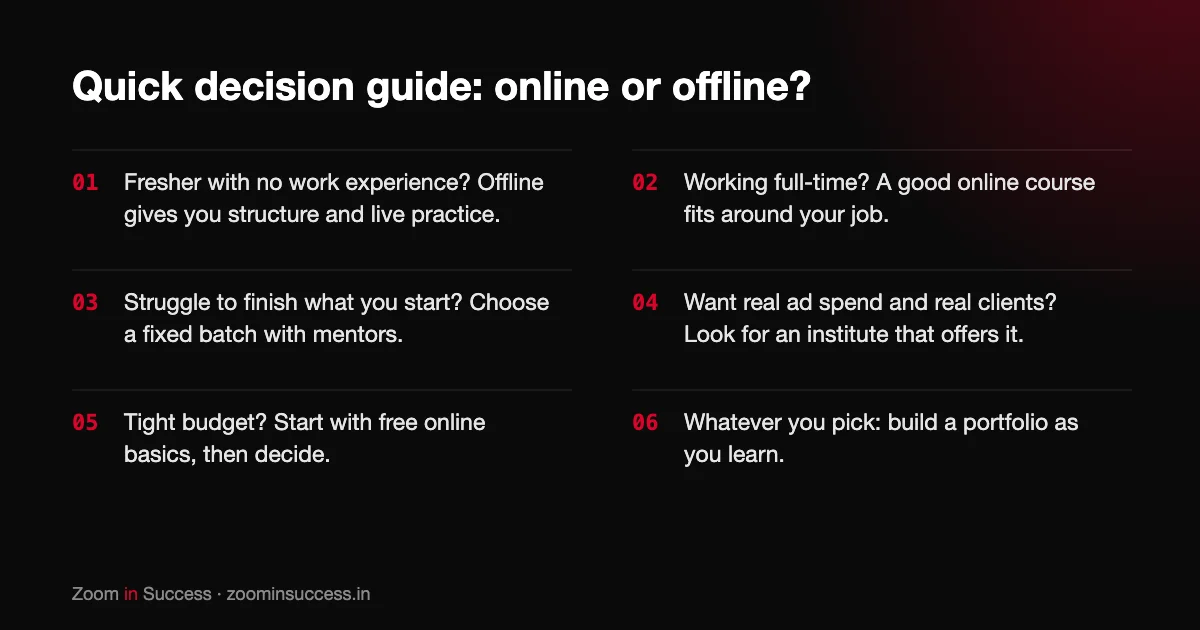
    • Choose an online course if you are already working, you are self-disciplined, and you mainly want to understand concepts.
    • Choose an offline institute if you are a fresher or switching careers, you want hands-on practice on real accounts, and you need someone to push you to finish.

    Online vs offline: side by side

    Online courseOffline institute
    CostFree to moderateModerate
    FlexibilityLearn anytime, anywhereFixed batch timings
    Live practiceMostly self-driven, often on dummy projectsReal ad accounts, real businesses, real budgets
    Doubt solvingComments, forums or emailFace to face, usually the same day
    CompletionDepends fully on your disciplineBatch, mentor and classmates keep you going
    NetworkingLimitedLocal businesses, trainers and peers
    Best forWorking professionals, self-startersFreshers, career switchers, small-town students

    Where online courses win

    1. Cost and access

    You can learn the basics of SEO, Meta Ads and Google Ads for free from Google Skillshop, Meta Blueprint and good YouTube channels. If money is tight, that is a perfectly good place to start.

    2. Flexibility

    If you have a job, a family business or college during the day, online learning fits around your schedule. You can pause, rewind and rewatch as many times as you need.

    3. Breadth of topics

    Online, you can find a course on almost any niche tool. That is useful once you already know the fundamentals and want to go deeper.

    Where offline institutes win

    1. You actually finish

    Most people who buy an online course never complete it. Not because they are lazy, but because nobody is waiting for them tomorrow. A fixed batch, a trainer who knows your name and classmates moving at the same pace make a huge difference.

    2. Real practice, not just theory

    Watching someone run a Meta Ads campaign is very different from running one yourself, with real money, and seeing why it isn’t getting leads. A good institute lets you work on live accounts and real client briefs. That is what employers and clients care about.

    3. Doubts get solved the same day

    When your ad gets rejected or your website breaks, you can turn to your trainer and fix it in five minutes, instead of spending two days searching forums.

    4. Local network

    In a city like Jind, a lot of first jobs and freelance projects come through people you know: local shops, coaching centres, clinics and real estate dealers. An offline institute connects you to that network.

    Quick decision guide: online or offline digital marketing course

    The mistake most students make

    The biggest mistake isn’t choosing online or offline. It’s collecting certificates without building anything. Whichever route you pick, an employer or client will ask one question: “What have you done?”

    So whatever you choose, make sure you finish with a portfolio: a few reels you made, an ad campaign you ran with real numbers, a website you built. We’ve written a full guide on how to build a digital marketing portfolio with zero clients.

    How to judge any course, online or offline

    1. Who teaches it? Ask whether the trainer runs real campaigns for real businesses today, not just teaches.
    2. Will you spend real money on ads? Practising on live ad accounts teaches more than any slide.
    3. Is the syllabus current? It should cover Meta Ads, Google Ads, SEO, content and reels, and AI tools, not just theory.
    4. Can you talk to past students? Real reviews beat any “100% placement” banner.
    5. Is the refund policy clear? A trustworthy institute puts it in writing.

    The best of both: hybrid learning

    Many students now do both. They learn the theory from free online resources and join an offline batch for practice, feedback and accountability. That is how we’ve set up our own digital marketing course in Jind: classroom sessions, live client briefs and recorded support if you miss a class.

    It works. More than 10 of our former students are now working in digital marketing roles, and every one of them got there by doing real work, not just watching videos.

    Frequently asked questions

    Can I get a job with only an online digital marketing course?

    Yes, if you also build a portfolio. Employers hire for proof of skills. A certificate alone rarely gets you the job.

    Is an offline digital marketing course worth it in a small city?

    It can be, because small cities are full of businesses that need help with Instagram, ads and websites. If the institute gives you live practice and local connections, you can start freelancing even before the course ends.

    How long does it take to learn digital marketing?

    You can learn the fundamentals in 2 to 3 months of focused practice. Becoming really good takes ongoing work on real projects, because the platforms keep changing.


    Still confused about which route is right for you? Visit us at Palika Bazaar, Jind, or message us on WhatsApp at +91 81685 27715. We’ll give you an honest answer, even if that answer is “start with the free stuff first”.