By Kunal Bansal, Founder, Zoom in Success · Career Guide
Every week, a student walks into our office in Jind with the same question: “Sir, YouTube pe sab free hai, toh institute kyun join karun?” It’s a fair question. There are thousands of online digital marketing courses, many of them free. So why would anyone pay for an offline digital marketing course at an institute?
The honest answer: neither option is better for everyone. The right choice depends on your situation, your discipline and what you want at the end of it. This guide breaks it down so you can decide for yourself.
| Online course | Offline institute | |
|---|---|---|
| Cost | Free to moderate | Moderate |
| Flexibility | Learn anytime, anywhere | Fixed batch timings |
| Live practice | Mostly self-driven, often on dummy projects | Real ad accounts, real businesses, real budgets |
| Doubt solving | Comments, forums or email | Face to face, usually the same day |
| Completion | Depends fully on your discipline | Batch, mentor and classmates keep you going |
| Networking | Limited | Local businesses, trainers and peers |
| Best for | Working professionals, self-starters | Freshers, career switchers, small-town students |
You can learn the basics of SEO, Meta Ads and Google Ads for free from Google Skillshop, Meta Blueprint and good YouTube channels. If money is tight, that is a perfectly good place to start.
If you have a job, a family business or college during the day, online learning fits around your schedule. You can pause, rewind and rewatch as many times as you need.
Online, you can find a course on almost any niche tool. That is useful once you already know the fundamentals and want to go deeper.
Most people who buy an online course never complete it. Not because they are lazy, but because nobody is waiting for them tomorrow. A fixed batch, a trainer who knows your name and classmates moving at the same pace make a huge difference.
Watching someone run a Meta Ads campaign is very different from running one yourself, with real money, and seeing why it isn’t getting leads. A good institute lets you work on live accounts and real client briefs. That is what employers and clients care about.
When your ad gets rejected or your website breaks, you can turn to your trainer and fix it in five minutes, instead of spending two days searching forums.
In a city like Jind, a lot of first jobs and freelance projects come through people you know: local shops, coaching centres, clinics and real estate dealers. An offline institute connects you to that network.
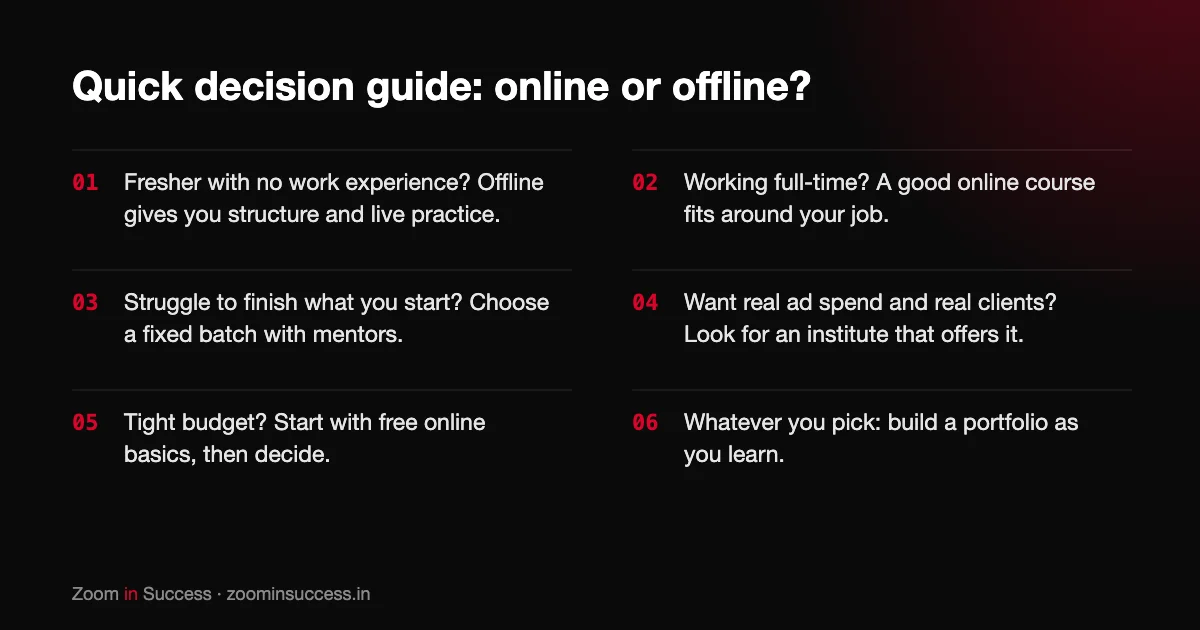
The biggest mistake isn’t choosing online or offline. It’s collecting certificates without building anything. Whichever route you pick, an employer or client will ask one question: “What have you done?”
So whatever you choose, make sure you finish with a portfolio: a few reels you made, an ad campaign you ran with real numbers, a website you built. We’ve written a full guide on how to build a digital marketing portfolio with zero clients.
Many students now do both. They learn the theory from free online resources and join an offline batch for practice, feedback and accountability. That is how we’ve set up our own digital marketing course in Jind: classroom sessions, live client briefs and recorded support if you miss a class.
It works. More than 10 of our former students are now working in digital marketing roles, and every one of them got there by doing real work, not just watching videos.
Yes, if you also build a portfolio. Employers hire for proof of skills. A certificate alone rarely gets you the job.
It can be, because small cities are full of businesses that need help with Instagram, ads and websites. If the institute gives you live practice and local connections, you can start freelancing even before the course ends.
You can learn the fundamentals in 2 to 3 months of focused practice. Becoming really good takes ongoing work on real projects, because the platforms keep changing.
Still confused about which route is right for you? Visit us at Palika Bazaar, Jind, or message us on WhatsApp at +91 81685 27715. We’ll give you an honest answer, even if that answer is “start with the free stuff first”.