By Kunal Bansal, Founder, Zoom in Success · Career Guide
It’s the classic trap: you can’t get clients without a portfolio, and you can’t build a portfolio without clients. Every fresher trying to build a digital marketing portfolio hits this wall.
Here’s the good news: you don’t need a paying client to prove you can do the work. You need real projects with real results, even small ones. This guide shows you exactly what to build, step by step.
Certificates show that you studied. A portfolio shows that you can deliver. When an agency or a business owner looks at your profile, they want to see three things:
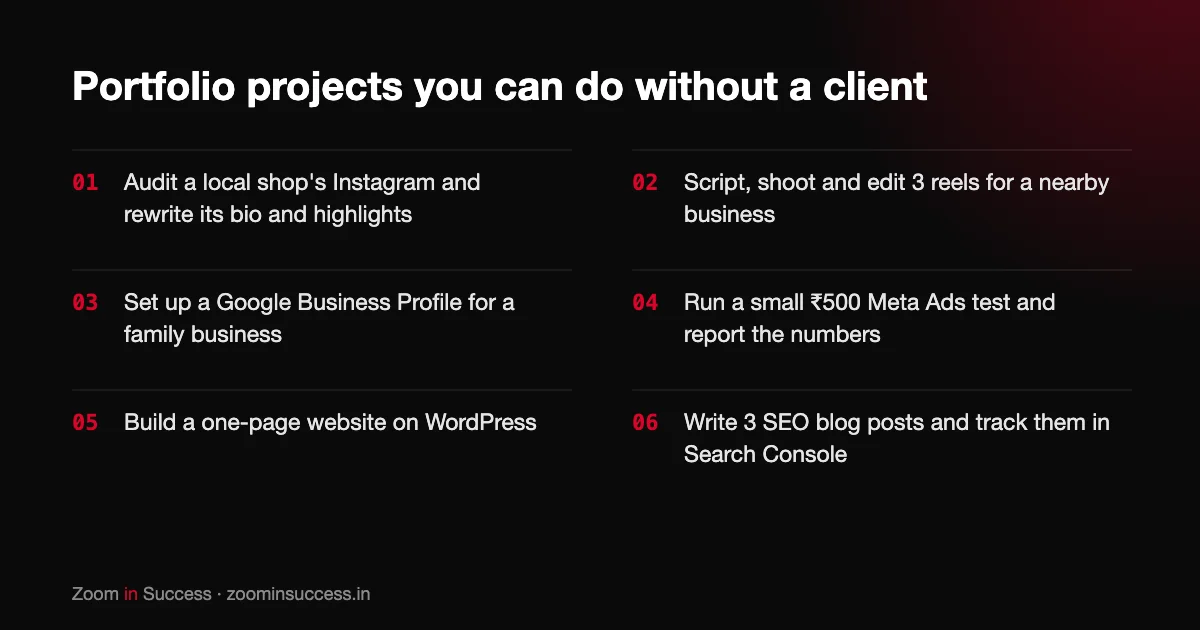
Pick a shop in your city whose Instagram page could be better. Write a one-page audit: what’s working, what isn’t, and five specific fixes (bio, highlights, posting pattern, reel ideas, call to action). Then show a “before vs after” mock-up of the profile.
Bonus: walk into the shop and show them the audit. That’s how many of our students land their first freelance client.
Offer a sweet shop, gym, boutique or coaching centre three free reels. Write a hook for each, shoot on your phone, and edit in CapCut. Track the views and saves after a week. Three reels with real numbers beat thirty imaginary ideas.
Many family businesses still aren’t on Google Maps properly. Set up or fix their Google Business Profile: correct category, photos, opening hours and the first few reviews. Screenshot the profile’s views and calls after a month. Local SEO is one of the most in-demand skills for small businesses.
Nothing teaches ads like spending your own money. Run a small campaign, for a friend’s business or even to promote your own reel. Set a clear goal, test two creatives, and write down the results: reach, clicks, cost per result, and what you’d change next time. Employers love a candidate who has actually seen Ads Manager.
Make a simple landing page for a real or imagined business: headline, services, testimonials, WhatsApp button, contact form. Make sure it’s fast and works on mobile. This also becomes your own portfolio site later.
Start a small blog on any topic you know well. Do keyword research, write three helpful posts, and connect Google Search Console. After a few weeks, screenshot your impressions and clicks. Even 50 impressions prove that you understand how search works.
Use the same simple structure for every project so it’s easy to read:
Be honest about the numbers. Small, real results are far more convincing than big, made-up ones, and a good interviewer will ask follow-up questions.
You can do all of this on your own. But it goes much faster when someone reviews your work and you get to practise on real client briefs. That’s the core of our digital marketing course in Jind: every student finishes with a portfolio, not just a certificate. More than 10 of our former students are now working in digital marketing roles.
Not sure whether to learn online or in a classroom? Read our honest comparison: online course vs offline institute.
Four to six strong projects across different skills, such as content, ads, SEO and a website, are enough to get interviews.
For two or three portfolio projects, yes. Agree on a clear, small scope and ask for a testimonial in return. After that, start charging, even if it’s a small amount.
Yes. Practical projects for local businesses, a small ad test with your own budget, and your own website or blog all count as real work, as long as you show honest results.
Want feedback on your portfolio? Message us on WhatsApp at +91 81685 27715 or visit our office at Palika Bazaar, Jind.